

Understanding The Science Behind The Lose For Life Method™
If you're here, there's a good chance you're curious.
Perhaps you've heard about the Lose For Life Method™ and want to understand what makes it different.
Or perhaps, like many women, you're feeling a little sceptical.
And honestly, I wouldn't blame you.
Most of us have been sold the dream before.
The promise that this time will be different.
The next diet.
The next plan.
The next set of rules.
Only to find ourselves back where we started weeks, months, or years later.
Like many women, my own journey with weight was not straightforward.
For years, I struggled with the same challenges that affect so many people today.
I experienced the frustration of losing weight, regaining it, starting again, and wondering why something that seemed so simple on paper could feel so difficult in reality.
That frustration led me to spend years studying the science, psychology, and behaviour behind weight loss.
Later, as a traditional weight-loss coach, I worked with hundreds of women and began noticing a pattern.
Many of them already knew what to eat.
Many understood the science of calories, nutrition, and weight loss.
Some could have taught the subject themselves.
Yet despite having the knowledge, they often found themselves repeating the same struggles.
Emotional eating.
Food noise.
All-or-nothing thinking.
Loss of motivation.
The lose-regain-start-again cycle.
It became increasingly clear that the problem was rarely a lack of information.
The problem was a lack of understanding around the biological, psychological, behavioural, neurological, and identity-based influences that shape eating behaviour and long-term weight regulation.
More importantly, very few women had ever been taught how to support those influences.
This led me to create the Weight Response System™.
A framework designed to help explain the many factors that influence our relationship with food, eating behaviour, and weight regulation.
But understanding the problem is only part of the solution.
Which is why I also created the Lose For Life Method™.
A framework designed to support the Weight Response System™ through evidence-informed nutritional principles, behavioural science, psychological tools, nervous system regulation, and identity-based change.
The purpose of this page is to help you understand the science behind that framework, why each component was included, and how they work together to support sustainable weight loss and long-term weight regulation.
Because once you understand the influences shaping your behaviour, you can begin working with them rather than constantly fighting against them.

WHAT YOU'LL LEARN
In this guide, you'll discover:
• Why I created the Weight Response System™ and how it explains the hidden influences shaping eating behaviour and weight regulation
• Why so many women struggle with the lose-regain-start-again cycle despite knowing what they should be doing
• How biology, psychology, neuroscience, behaviour, and identity interact to influence food choices, habits, cravings, and consistency
• The science behind the Lose For Life Method™ and why it was designed differently from traditional weight-loss approaches
• How the Four Core Pillars™ support the biological, behavioural, emotional, and neurological influences that shape long-term success
• Why the Regulate & Liberate™ Practices incorporate approaches such as CBT, NLP, cognitive hypnosis, somatic techniques, EFT tapping, breathwork, and behavioural science
• How the Nutrition Pathways™ support appetite regulation, blood sugar stability, hormone health, energy, and sustainable weight regulation
• Why lasting change is often less about willpower and more about creating the right conditions for success
• How the different components of the Lose For Life Method™ work together to support both weight loss and long-term weight regulation
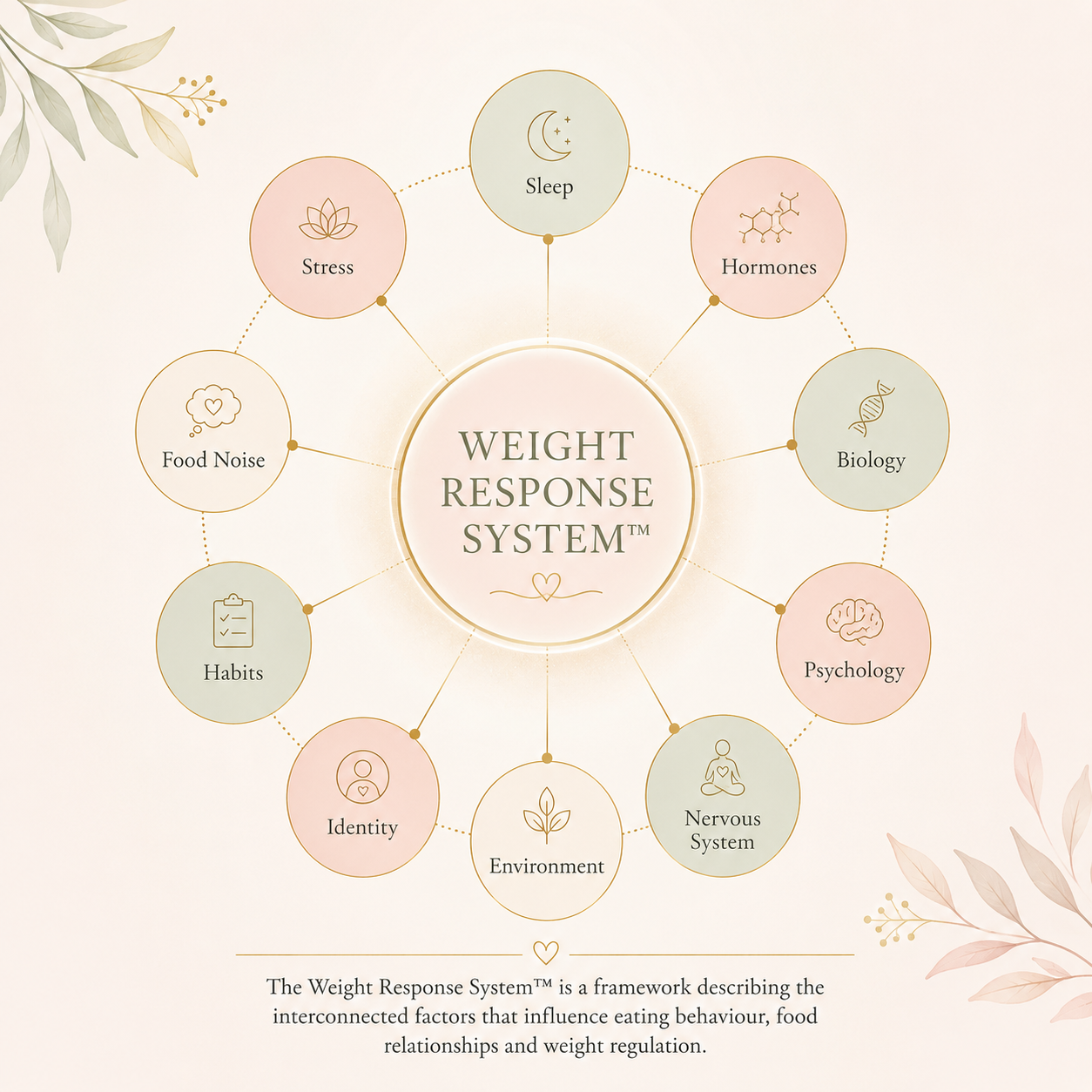
Understanding The Weight Response System™
Before we explore the individual influences that shape eating behaviour and weight regulation, it's helpful to understand the foundation of the Lose For Life Method™.
The Weight Response System™ recognises that our relationship with food and weight is influenced by far more than food alone.
Biology.
Psychology.
Neuroscience.
Stress.
Sleep.
Habits.
Identity.
Food noise.
Emotions.
Environment.
These factors constantly interact, influencing how we think, feel, eat, and respond.
The diagram above illustrates the key influences that make up the Weight Response System™.
The Weight Response System™ was created to help explain why weight loss and weight regulation often feel far more complex than simply knowing what to eat.
Rather than viewing eating behaviour through a single lens, it recognises that multiple influences are constantly interacting beneath the surface.
Understanding these influences is important.
However, understanding the system is only the first step.
The next step is learning how to support it.
This is where the Lose For Life Method™ begins.

The Lose For Life Method™
The Weight Response System™ explains the influences that shape eating behaviour, weight loss, and long-term weight regulation.
The Lose For Life Method™ was created to support that system.
Rather than focusing solely on food intake, exercise, or willpower, the method recognises that eating behaviour is influenced by biological, psychological, behavioural, neurological, and identity-based factors that constantly interact with one another.
When these influences are unsupported, the Weight Response System™ can come under pressure.
Over time, this pressure can contribute to resistance, emotional eating, food focus, all-or-nothing thinking, and the lose-regain-start-again cycle.
The goal of the Lose For Life Method™ is not to create more pressure.
It is to provide support.
This support is delivered through three interconnected components:
- THE FOUR CORE PILLARS™ -
The pillars provide the foundation of the framework and target some of the most influential drivers of eating behaviour and weight regulation.
- The Regulate & Liberate™ Practices -
The practices provide psychological, behavioural, neurological, emotional, and identity-based support designed to help women create sustainable change.
- The Nutrition Pathways™ -
The pathways provide biological support while recognising that different women experience different challenges, needs, and life circumstances.
- Why The Method Uses Multiple Pathways-
One of the core principles behind Lose For Life is that one size rarely fits all.
The challenges experienced by a woman navigating perimenopause are often different from those experienced by a woman living with ADHD.
The needs of someone using a GLP-1 medication may differ from someone following a more traditional pathway.
While the underlying principles remain the same, the support required may vary.
This is why the Lose For Life Method™ is delivered through four pathways:
• Core
• Midlife
• ADHD
• GLP-1
Each pathway applies the same foundational framework while adapting the support to reflect the realities of different experiences.
Because lasting change becomes easier when support feels relevant, practical, and sustainable. And the one thing that has been proven time and time again with weight loss, is that one size does not always fit all.
The sections that follow explain the scientific principles behind each component of the Lose For Life Method™ and why they were included within the framework.

The Science Behind The Four Core Pillars™
The Four Core Pillars™ form the foundation of the Lose For Life Method™.
They were selected because research across nutrition science, behavioural psychology, neuroscience, endocrinology, and nervous system regulation consistently shows that eating behaviour is influenced by multiple interacting systems rather than food intake alone.
Each pillar was designed to support a different aspect of the Weight Response System™ and reduce some of the pressures that commonly contribute to emotional eating, food noise, inconsistency, and the lose-regain-start-again cycle.
Together, the pillars create the foundation upon which the Nutrition Pathways™ and Regulate & Liberate™ Practices are built.
- Pillar 1: Blood Sugar Stability -
One of the most well-established findings within nutritional science is that blood sugar regulation influences far more than energy levels alone.
Blood glucose fluctuations can affect appetite regulation, hunger signals, cravings, concentration, mood, cognitive performance, and food-seeking behaviour.
Research suggests that rapid rises and falls in blood sugar may contribute to increased hunger, reduced satiety, stronger cravings, and a greater tendency towards reactive eating.
From a neurological perspective, fluctuating blood sugar can also influence decision-making, impulse control, and reward-seeking behaviour.
This means that food choices are not simply influenced by willpower.
They are influenced by biological signals that affect how the brain and body respond throughout the day.
For this reason, the Lose For Life Method™ incorporates principles drawn from nutritional therapy, appetite regulation research, and metabolic health science.
Protein intake, fibre intake, meal structure, hydration, and food quality are emphasised because they help create more stable physiological conditions in which appetite regulation can function effectively.
The goal is not perfect control.
The goal is biological support.
- Scientific Principles Supporting This Pillar -
• Appetite regulation
• Blood glucose stability
• Satiety signalling
• Nutritional therapy
• Metabolic health
• Behavioural nutrition science
- What This Pillar Aims To Achieve -
• Improved appetite regulation
• Reduced cravings
• Increased satiety
• Greater energy stability
• Reduced reactive eating
• Improved consistency with food choices
-Pillar 2: Hormone Support-
Hormones act as chemical messengers that influence appetite, energy balance, mood, sleep, fat storage, stress responses, and overall wellbeing.
Research has demonstrated that hormonal changes can influence hunger signals, food preferences, emotional sensitivity, cravings, and energy levels.
These influences become particularly noticeable during periods of hormonal transition, including perimenopause and menopause, but are relevant across all stages of life.
Hormones do not determine behaviour.
However, they can create biological conditions that make certain behaviours more likely.
For example, disrupted sleep may influence appetite-regulating hormones.
Chronic stress may influence cortisol responses.
Hormonal fluctuations may influence cravings, energy, and emotional regulation.
The Lose For Life Method™ incorporates hormone-supportive principles through nutrition, hydration, sleep awareness, stress management, and pathway-specific adaptations.
Rather than attempting to override hormonal influences, the framework aims to create conditions that support the body's natural regulatory processes.
- Scientific Principles Supporting This Pillar -
• Endocrinology
• Appetite regulation research
• Stress physiology
• Sleep science
• Women's health research
• Hormonal adaptation
- What This Pillar Aims To Achieve -
• Greater awareness of hormonal influences
• Improved energy regulation
• Reduced biological stress
• Increased sustainability during hormonal transitions
• Better support for long-term weight regulation
- Pillar 3: Nervous System Regulation -
The nervous system plays a central role in behavioural regulation.
Modern neuroscience increasingly recognises that stress, emotional overwhelm, chronic activation, and nervous system dysregulation can significantly influence eating behaviour.
When the brain perceives threat, pressure, overwhelm, or emotional discomfort, behavioural flexibility often decreases.
People become more likely to rely on familiar coping strategies, habits, and reward-seeking behaviours.
For many individuals, food becomes part of that response.
This is one reason why knowing what to do is often not enough.
The nervous system influences what feels possible in a given moment.
The Lose For Life Method™ incorporates approaches drawn from nervous system regulation, somatic psychology, breathwork, movement-based regulation, emotional awareness, and stress-management research.
These approaches help reduce physiological arousal, increase emotional regulation, and improve behavioural flexibility.
The goal is not to eliminate stress.
The goal is to reduce the pressure stress places on the Weight Response System™.
- Scientific Principles Supporting This Pillar -
• Nervous system regulation
• Polyvagal-informed principles
• Somatic psychology
• Stress physiology
• Emotional regulation research
• Behavioural neuroscience
- What This Pillar Aims To Achieve -
• Improved emotional regulation
• Reduced emotional reactivity
• Increased resilience to stress
• Reduced reliance on food as a coping strategy
• Greater behavioural flexibility
- Pillar 4: Behaviour & Identity Shift -
Research from behavioural psychology, cognitive science, neuroscience, and identity-based change consistently demonstrates that lasting behaviour change requires more than information alone.
Knowledge does not automatically create transformation.
Many women already possess substantial knowledge about nutrition and weight loss.
The challenge often lies in translating knowledge into sustainable behaviour.
Behaviour is influenced by thoughts, beliefs, emotions, habits, self-concept, learned experiences, and neural pathways.
Over time, repeated behaviours strengthen neural connections within the brain.
The more frequently a thought pattern or behaviour is repeated, the more automatic it can become.
This process is known as neuroplasticity.
The Behaviour & Identity Shift pillar was designed to address these deeper influences through evidence-informed approaches including Cognitive Behavioural Therapy (CBT), Neuro-Linguistic Programming (NLP), cognitive hypnosis, behavioural psychology, cognitive restructuring, and identity-based change.
CBT helps individuals identify and challenge unhelpful thinking patterns that influence behaviour.
NLP explores how internal language, attention, mental imagery, and learned associations shape behavioural responses.
Cognitive hypnosis uses focused attention, visualisation, and mental rehearsal to support emotional regulation, behavioural change, and future-self development.
Behavioural psychology and neuroplasticity research demonstrate that repeated experiences can strengthen new neural pathways and gradually make new responses feel more automatic.
Together, these approaches help address not only behaviour itself, but the psychological and neurological processes that drive behaviour.
- Scientific Principles Supporting This Pillar -
• Cognitive Behavioural Therapy (CBT)
• Neuro-Linguistic Programming (NLP)
• Cognitive hypnosis
• Behavioural psychology
• Neuroplasticity
• Identity-based change
• Self-concept theory
- What This Pillar Aims To Achieve -
• Increased self-awareness
• Improved self-trust
• Reduced all-or-nothing thinking
• Greater psychological flexibility
• Stronger behavioural consistency
• Identity-level support for change
• Development of new neural pathways that support sustainable behaviour
The goal is not simply to lose weight.
The goal is to create the psychological, behavioural, and neurological conditions that make sustainable change easier to maintain over time.

The Science Behind The Regulate & Liberate™ Practices
While the Four Core Pillars™ provide the foundation of the Lose For Life Method™, the Regulate & Liberate™ Practices provide the practical tools that help women apply the framework in everyday life.
These practices were designed to support the psychological, behavioural, neurological, emotional, and identity-based influences that shape eating behaviour.
Drawing from Cognitive Behavioural Therapy (CBT), Neuro-Linguistic Programming (NLP), cognitive hypnosis, behavioural psychology, neuroscience, somatic approaches, breathwork, and Emotional Freedom Techniques (EFT), the practices help address some of the deeper influences within the Weight Response System™.
The goal is not simply to understand behaviour.
The goal is to create opportunities to change it.
PRACTICE 1: AWARENESS™
- Scientific Foundation -
Research across behavioural psychology and cognitive science consistently shows that awareness is often the first step in behaviour change.
Many eating behaviours occur automatically.
Habits, emotional responses, environmental triggers, and learned patterns frequently operate outside conscious awareness.
Without awareness, behaviour often remains on autopilot.
- Why It Was Included -
The Awareness™ practice helps women identify the patterns, triggers, thoughts, emotions, and behaviours influencing their relationship with food.
- What It Aims To Achieve -
• Increased self-awareness
• Identification of behavioural patterns
• Greater understanding of triggers
• Improved decision-making
• Reduced automatic eating behaviours
PRACTICE 2: RELEASE™
- Scientific Foundation -
Stress physiology, somatic psychology, emotional regulation research, breathwork, and EFT research all suggest that emotional pressure can significantly influence behaviour.
When emotions remain unprocessed, people often seek relief through familiar coping strategies.
Food is one of the most common.
Somatic approaches recognise that emotional experiences are often felt within the body as well as the mind.
- Why It Was Included -
Release™ was designed to help women process emotional pressure rather than continually coping with it through food.
Techniques may include breathwork, somatic exercises, emotional awareness practices, EFT tapping, and guided emotional processing.
- What It Aims To Achieve -
• Reduced emotional pressure
• Improved emotional regulation
• Reduced emotional eating
• Increased resilience
• Greater connection between mind and body
PRACTICE 3: REPATTERN EMOTIONAL EATING™
- Scientific Foundation-
Neuroscience demonstrates that repeated behaviours strengthen neural pathways.
Behavioural psychology shows that habits often develop through repetition, reinforcement, and learned associations.
Many emotional eating patterns become automatic over time.
The brain learns to associate certain emotions with food-based relief.
- Why It Was Included -
Repattern Emotional Eating™ helps interrupt automatic emotional eating responses and strengthen alternative behavioural pathways.
Drawing upon CBT, NLP, behavioural psychology, and neuroscience, the practice focuses on changing the response rather than simply suppressing the urge.
- What It Aims To Achieve -
• Reduced emotional eating
• Greater behavioural flexibility
• Stronger alternative coping strategies
• Increased self-regulation
• Development of healthier neural pathways
PRACTICE 4: REPATTERN EMOTIONAL WEIGHT™
- Scientific Foundation -
Identity research, behavioural psychology, self-concept theory, and cognitive science suggest that long-term behaviour often reflects deeply held beliefs about ourselves.
Many women carry emotional experiences, beliefs, and narratives that influence their relationship with weight.
These beliefs can operate beneath conscious awareness while continuing to influence behaviour.
- Why It Was Included -
Repattern Emotional Weight™ was designed to explore and update the emotional and psychological patterns that may be contributing to ongoing struggles with weight regulation.
- What It Aims To Achieve -
• Increased self-awareness
• Reduced self-sabotage
• Greater emotional freedom
• Improved self-trust
• Support for long-term behavioural change
PRACTICE 5: SHIFT YOUR INNER NARRATIVE™
- Scientific Foundation -
Cognitive Behavioural Therapy, cognitive restructuring, and self-talk research consistently demonstrate that internal dialogue influences emotional states, decision-making, confidence, and behaviour.
The stories we repeatedly tell ourselves often shape the actions we take.
- Why It Was Included -
Inner Narrative™ helps women identify, challenge, and reshape the internal dialogue influencing their relationship with food, weight, and themselves.
- What It Aims To Achieve -
• Reduced self-criticism
• Improved self-compassion
• Increased confidence
• Greater psychological flexibility
• More supportive thought patterns
- PRACTICE 6: BECOME™ -
- Scientific Foundation -
Identity-based change research suggests that lasting behaviour change becomes easier when actions align with self-concept.
Neuroscience also shows that visualisation, mental rehearsal, and future-self thinking can activate many of the same neural networks involved in real-world behaviour.
Cognitive hypnosis and guided imagery techniques build upon these principles.
- Why It Was Included -
Become™ helps women strengthen the identity of the person they are becoming rather than remaining attached to the identity of the person they have always been.
Through future-self work, visualisation, cognitive hypnosis, and identity-based practices, women begin creating greater alignment between their goals and their self-image.
- What It Aims To Achieve -
• Stronger self-belief
• Increased behavioural consistency
• Identity-level change
• Improved motivation
• Greater alignment between actions and goals
• Support for sustainable weight regulation
WHY THE PRACTICES WORK TOGETHER
The Regulate & Liberate™ Practices were designed to work alongside the Four Core Pillars™ and Nutrition Pathways™.
Where the Pillars provide foundational support and the Nutrition Pathways™ provide biological support, the Practices focus on the psychological, behavioural, emotional, neurological, and identity-based influences that shape behaviour.
Together, they help women move beyond information alone and begin creating the conditions that make lasting change possible.

The Science Behind The Nutrition Pathways™
The Science Behind The Nutrition Pathways™
Nutrition plays a central role within the Weight Response System™.
Food influences appetite regulation, blood sugar stability, energy levels, hormones, inflammation, satiety, mood, cognitive performance, and overall wellbeing.
However, one of the biggest challenges within the weight-loss industry is the assumption that everyone requires the same nutritional approach.
Research and clinical experience suggest otherwise.
Different individuals experience different biological influences, life stages, health challenges, behavioural patterns, and support requirements.
This is one reason why the Lose For Life Method™ does not use a single meal plan.
Instead, it provides four Nutrition Pathways™ that apply the same evidence-informed principles while allowing the framework to adapt to different needs.
The goal is not restriction.
The goal is biological support.
- The Scientific Principles Behind The Nutrition Pathways™ -
While each pathway is tailored to different circumstances, they are all built upon the same foundational principles.
- Nutritional Therapy -
Nutritional therapy recognises that food provides more than calories.
It provides the nutrients required to support energy production, appetite regulation, hormonal function, metabolic health, recovery, and overall wellbeing.
The Lose For Life Method™ incorporates nutritional therapy principles to ensure that nutrition supports the body rather than simply reducing calorie intake.
- Protein & Satiety -
Research consistently demonstrates that protein plays an important role in satiety, appetite regulation, muscle maintenance, blood sugar stability, and weight management.
Higher protein intake has been associated with improved fullness, reduced hunger, and better dietary adherence.
This is one reason protein forms a key component of each Nutrition Pathway™.
- Fibre & Gut Health -
Dietary fibre supports digestive health, blood sugar regulation, satiety, and the gut microbiome.
Research increasingly suggests that gut health may influence appetite regulation, inflammation, metabolic health, and overall wellbeing.
For this reason, fibre-rich foods are encouraged throughout the pathways.
- Blood Sugar Stability -
Blood sugar fluctuations can influence hunger, cravings, mood, concentration, energy levels, and eating behaviour.
The pathways are designed to support more stable blood sugar responses through balanced meal composition, protein intake, fibre intake, and meal structure.
This helps reduce biological pressure on the Weight Response System™ and create a more stable foundation for behaviour change.
- Inflammation & Metabolic Health -
Chronic low-grade inflammation has been associated with a range of health outcomes, including metabolic dysfunction, insulin resistance, fatigue, and reduced wellbeing.
While nutrition alone cannot eliminate inflammation, research suggests that dietary patterns rich in whole foods, fruits, vegetables, fibre, healthy fats, and minimally processed foods may help support overall health.
For this reason, the pathways encourage anti-inflammatory nutritional principles rather than highly processed dietary patterns.
- Hormone Support -
Nutrition influences many of the biological systems involved in hormonal health.
Blood sugar regulation, nutrient intake, hydration, sleep quality, and stress management all interact with hormonal function.
This is particularly relevant during periods of hormonal transition such as perimenopause and menopause.
The pathways are designed to support these processes rather than work against them.
- The 80/20 Principle -
Behavioural science consistently demonstrates that highly restrictive approaches are difficult to sustain long term.
Rigid food rules often increase food focus, all-or-nothing thinking, perceived restriction, and the likelihood of repeated cycles of dieting and overeating.
The Lose For Life Method™ incorporates an 80/20 approach because sustainability matters.
The goal is not perfection.
The goal is consistency.
Research suggests that flexible approaches to eating are often associated with greater long-term adherence and a healthier relationship with food.
- Why Four Different Pathways? -
The scientific principles remain the same.
The support required may differ.
- Core Pathway™ -
Designed for women seeking a balanced, sustainable approach to weight loss and weight regulation.
- Midlife Pathway™-
Adapted to reflect some of the biological and hormonal influences commonly experienced during perimenopause and menopause.
- ADHD Pathway™ -
Incorporates considerations around executive function, impulsivity, dopamine-seeking behaviours, routine formation, and behavioural consistency.
- GLP-1 Pathway™ -
Designed to support women using GLP-1 medications by helping maintain nutritional adequacy, protein intake, muscle preservation, sustainable eating behaviours, and long-term weight regulation.
- What The Nutrition Pathways™ Aim To Achieve -
• Improved appetite regulation
• Increased satiety
• Greater blood sugar stability
• Reduced cravings
• Better energy regulation
• Improved nutritional adequacy
• Reduced food-related stress
• Greater sustainability
• Long-term support for weight loss and weight regulation
- Why The Nutrition Pathways™ Matter -
The Nutrition Pathways™ were not designed to be another diet.
They were designed to provide biological support for the Weight Response System™.
Rather than relying on restriction, food rules, or short-term compliance, the pathways aim to create conditions that make sustainable behaviour change easier to maintain.
Because lasting change is rarely achieved through pressure alone.
It is far more likely to occur when the body and mind are supported together.
- Can I Follow A Different Nutritional Approach? -
Absolutely.
One of the most important discoveries that shaped the Lose For Life Method™ was recognising that nutrition is only one part of the picture.
While food plays an important role in appetite regulation, energy balance, satiety, blood sugar stability, and overall health, it is only one component of the Weight Response System™.
Many women have successfully lost weight at various points in their lives.
The challenge is often not whether weight loss is possible.
The challenge is whether it becomes sustainable.
This is one reason the Lose For Life Method™ places equal importance on psychology, behaviour, identity, nervous system regulation, and long-term habit change.
The Nutrition Pathways™ provide one evidence-informed approach to supporting the biological layer of the Weight Response System™.
However, if you already follow a nutritional approach that works well for you, that is perfectly okay.
The goal is not to convince you that there is only one way to eat.
The goal is to ensure that your chosen approach supports the wider framework rather than working against it.
As a general guide, any nutritional approach used alongside the Lose For Life Method™ should aim to be:
• Balanced
• Sustainable
• Nutritionally adequate
• Supportive of blood sugar regulation
• Supportive of hormonal health
• Realistic for long-term living
• Free from unnecessary restriction
Because the purpose of nutrition within the framework is not to create more pressure.
It is to provide support.
The Weight Response System™ does not require perfection.
It requires consistency, nourishment, and an approach that you can realistically sustain over time.

Bringing It All Together
The Weight Response System™ was created to explain something many women have experienced for years:
Weight loss is rarely just about food.
Biology influences behaviour.
Psychology influences behaviour.
Neuroscience influences behaviour.
Identity influences behaviour.
Stress influences behaviour.
And all of these influences constantly interact with one another.
This is one reason why so many women find themselves trapped in the lose-regain-start-again cycle despite knowing what they "should" be doing.
The challenge is rarely a lack of knowledge.
The challenge is often a lack of support.
The Lose For Life Method™ was designed to provide that support.
The Four Core Pillars™ support the biological, behavioural, emotional, and neurological influences that shape eating behaviour.
The Regulate & Liberate™ Practices provide practical tools designed to support emotional regulation, behavioural flexibility, identity change, self-awareness, and the development of new neural pathways.
The Nutrition Pathways™ provide a sustainable approach to biological support through evidence-informed nutritional principles that help create the conditions for lasting change.
Together, these components work to support the Weight Response System™ as a whole.
Not through restriction.
Not through punishment.
Not through perfection.
But through support.
Because lasting change is rarely achieved by fighting against yourself.
It becomes far easier when your biology, psychology, behaviour, identity, and environment begin working together rather than pulling in different directions.
My hope is that understanding the science behind the Lose For Life Method™ helps you approach this journey differently.
With greater awareness.
Greater self-compassion.
And perhaps most importantly, a deeper understanding that your struggles were never simply about willpower.
You are not broken.
You do not need fixing.
You need the right support.
And that is exactly what the Lose For Life Method™ was designed to provide.
Thank you for trusting me to be part of your journey.
Now let's put the science into practice.